The Canary Current Upwelling System is one of the most productive ocean regions on Earth. At the same time, it lies directly beneath the world's major atmospheric dust transport pathways, receiving large amounts of Saharan dust every year.
For decades, researchers have recognised that both upwelling and atmospheric dust can influence marine productivity and carbon export. Yet separating their respective contributions has proven remarkably difficult. Upwelling, dust deposition and mesoscale circulation often occur simultaneously, interact with each other, and can produce similar responses in the surface ocean. Disentangling the relative influence of these processes remains one of the major challenges in understanding carbon cycling in eastern boundary upwelling systems downwind of major continental deserts.
In our new paper, published in Biogeosciences, we sought to address this challenge within the framework of the CHASE and PRIMUS projects, which aimed to improve our understanding of the links between atmospheric forcing, oceanographic circulation, marine primary production and particle export in the Canary Current System.
To do so, we combined long-term sediment-trap observations from two sites in the Canary Current System with satellite-derived estimates of Chl-a, primary production and particulate inorganic carbon (PIC), atmospheric observations, and Lagrangian particle-tracking simulations. By linking satellite-derived productivity budgets to the upstream history of the water masses reaching the sediment-trap sites, we were able to move beyond simple local correlations and investigate the seasonal imprint of dust deposition, upwelling and mesoscale circulation on deep-ocean particle fluxes.
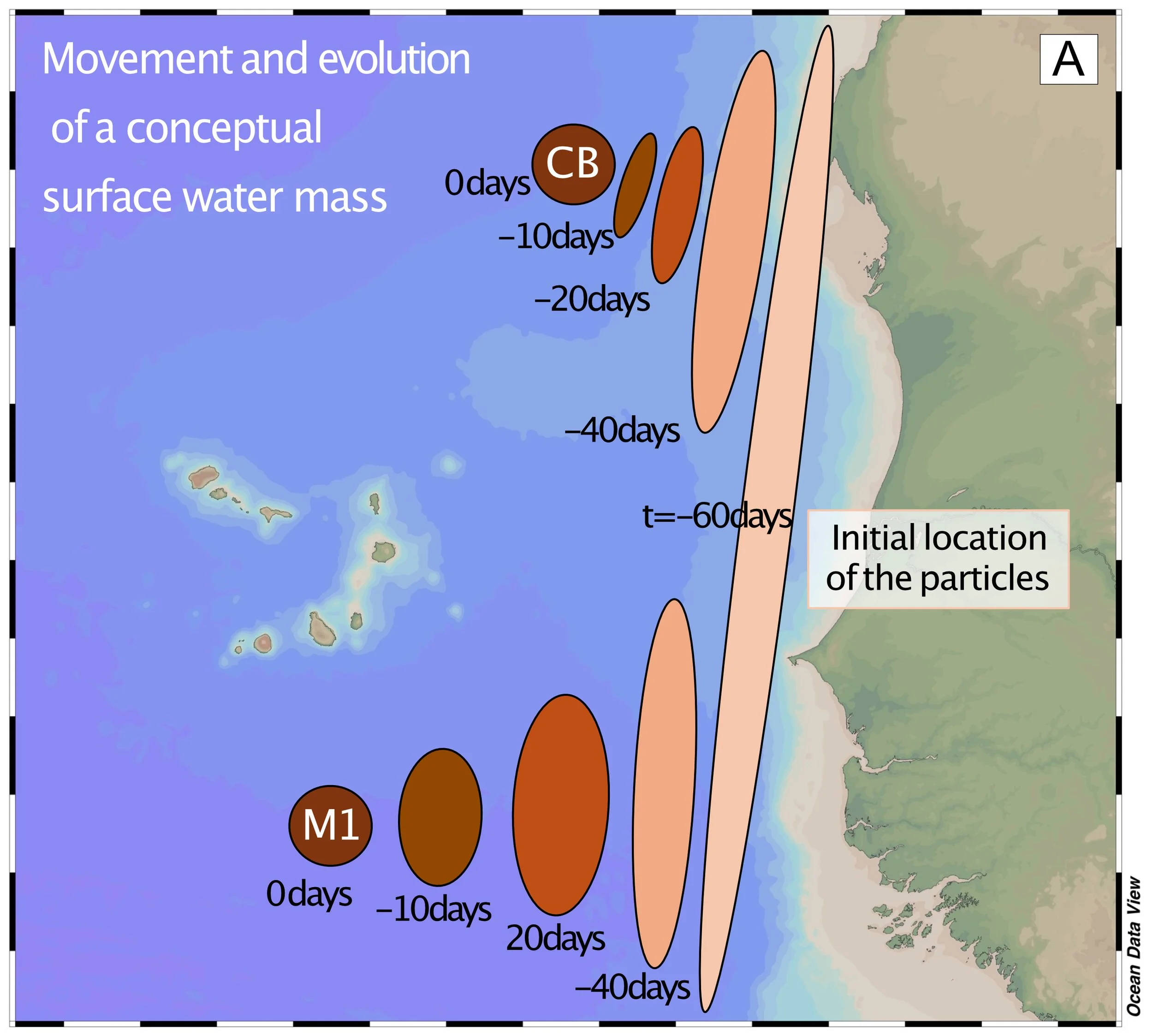
Schematic representation of the dominant upstream pathways and seasonal evolution of the surface water masses reaching the CB and M1 sediment-trap sites. The conceptual model is based on Lagrangian backtracking of virtual surface particles and links coastal–offshore transport pathways with the observed variability in satellite-derived chlorophyll-a (Chl-a), primary production (PP), and particulate inorganic carbon (PIC).
While many uncertainties remain and further work is needed to establish causal relationships, our results reveal two contrasting seasonal export regimes. During late winter and spring, intensified mixing, upwelling and cross-shelf transport sustain elevated productivity and a PIC-rich export regime dominated by fast-blooming coccolithophore species. During summer and autumn, when stratification increases and surface productivity declines, Saharan dust appears to play a more prominent role in maintaining deep particle fluxes, primarily through mineral ballasting and, episodically, through fertilisation responses. Together, these findings suggest that the relative importance of physical and atmospheric drivers changes substantially throughout the year, leaving distinct seasonal signatures on deep-ocean particle export.
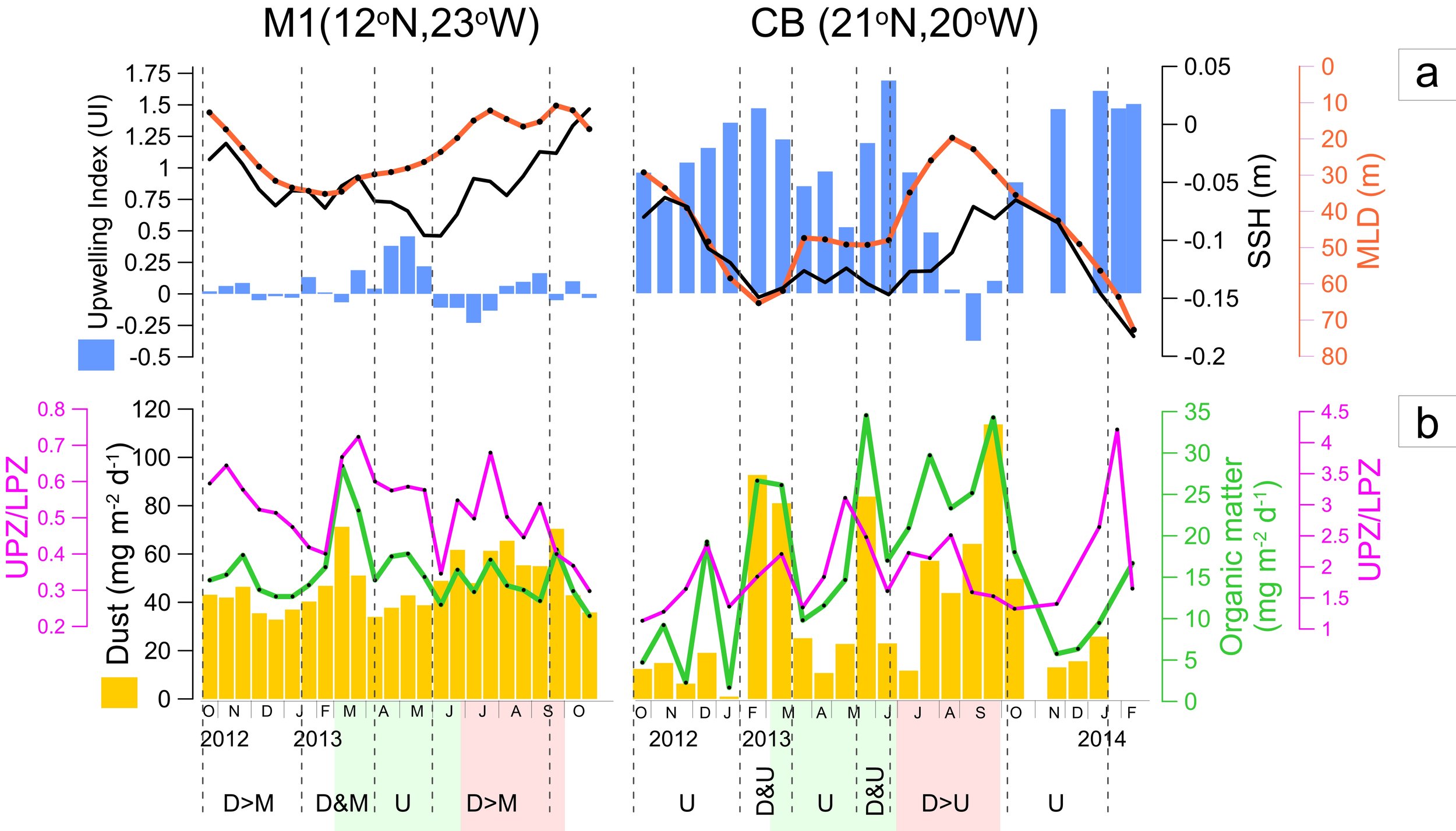
Seasonal evolution of physical forcing and export-related indicators at the M1 and CB sediment-trap sites. (a) sea surface temperature (SST)-based upwelling index, sea surface height (SSH), and mixed-layer depth (MLD). (b) Organic matter flux, dust flux (lithogenic material), and coccolithophore UPZ/LPZ ratio. Shaded areas indicate spring and summer. Labels D, M and U identify periods primarily associated with dust deposition, mixing, and upwelling, respectively. Particle flux data from Korte et al. (2017) and Guerreiro et al. (2019, 2021).
An additional strength of the study is the use of coccolithophores as model organisms to investigate atmosphere–ocean interactions. Their species composition, depth habitat preferences, and contribution to carbonate export make them particularly powerful sentinels of environmental change in the ocean. Because different species occupy distinct ecological niches and respond differently to changes in nutrient supply, stratification, and water-mass structure, coccolithophore assemblages provide a unique framework for tracing the combined influence of atmospheric deposition, ocean circulation, and ecological dynamics on carbon export.
Beyond the regional implications, these findings contribute to a broader challenge in ocean biogeochemistry: improving our understanding and representation of the processes that regulate carbon export to the deep ocean. By providing new observational constraints on the seasonal interplay between dust deposition, upwelling and mesoscale circulation, this work helps refine the conceptual frameworks and modelling approaches used to represent the biological and carbonate carbon pumps in biogeochemical and Earth-system models.
📄 Read the paper: https://bg.copernicus.org/articles/23/5133/2026/
Guerreiro, C. V. et al. 2026. Seasonal upwelling–dust controls on export production in the Canary Current System revealed by Lagrangian particle tracking, Biogeosciences, 23, 5133–5161, https://doi.org/10.5194/bg-23-5133-2026,