Our Research Topic “Aerosol deposition in the ocean: drivers and biogeochemical effects” is now complete, with the publication of our Editorial in Frontiers in Marine Science. Co-edited by Catarina V. Guerreiro, Jan-Berend W. Stuut, Cécile Guieu and Tim Jickells, this collection brings together studies addressing a a seemingly simple question question: what happens when material transported through the atmosphere reaches the ocean?
Atmospheric aerosols connect continents, atmosphere and ocean over enormous distances. Mineral dust, volcanic ash, wildfire and anthropogenic aerosols can deliver nutrients to surface waters, potentially affecting marine productivity, plankton communities and carbon cycling. Yet the studies gathered here show that more atmospheric deposition does not necessarily mean greater nutrient availability, productivity or carbon sequestration.
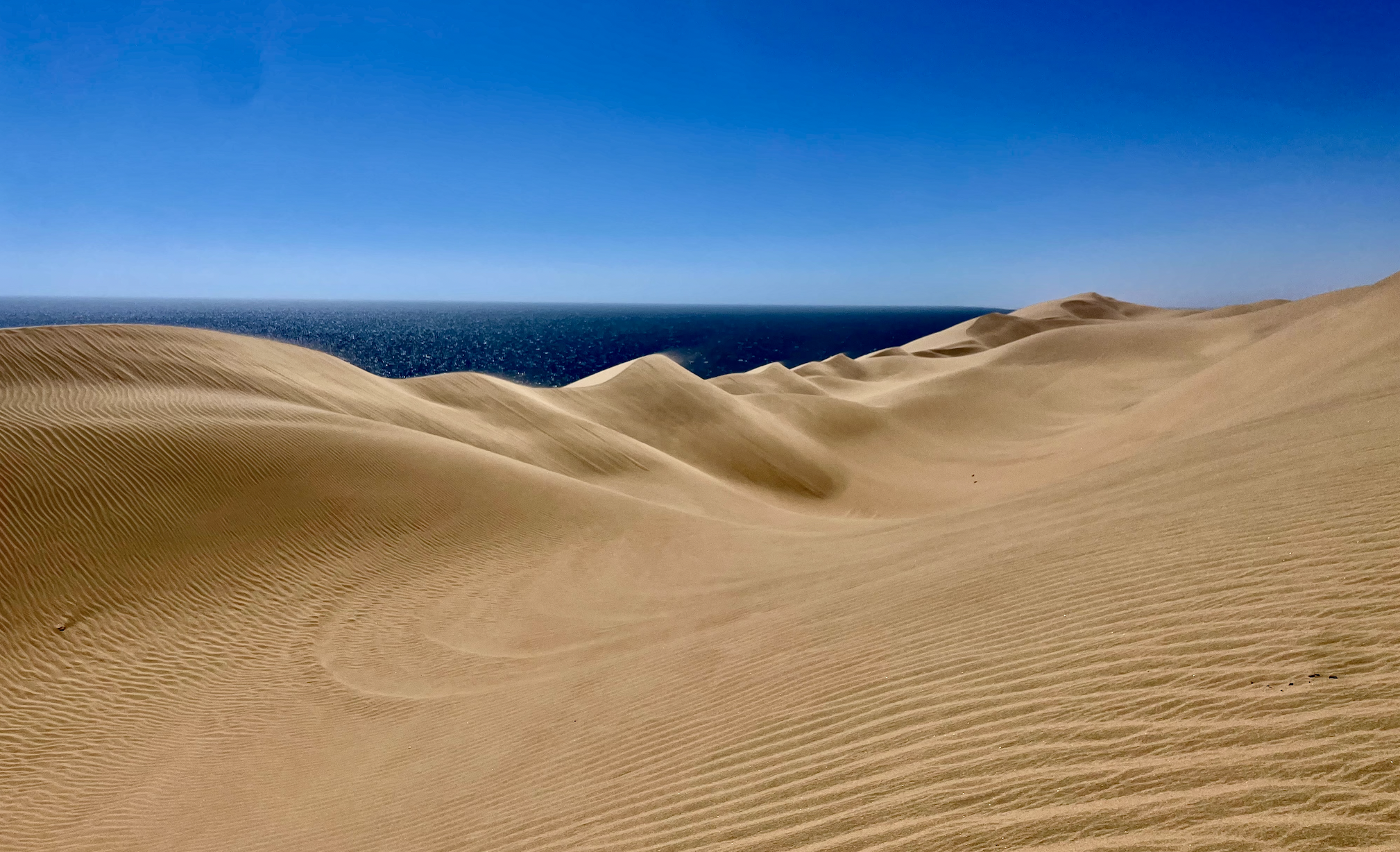
Where desert meets ocean: the Namib Desert along the Atlantic coast of Namibia, illustrating the close links between terrestrial dust sources and the marine environment. Photo: Catarina V. Guerreiro.
Using approaches ranging from numerical modelling and laboratory experiments to high-resolution sediment-trap observations, the contributions explore these processes across very different ocean regions.
Manon Malsang et al. investigate how rising anthropogenic nitrogen deposition may partly offset climate-driven declines in primary production in some regions of the northern Indian Ocean. Blanda Matzenbacher et al. and van Boxtel et al. use high-resolution sediment-trap records from the tropical North Atlantic and eastern Mediterranean to examine how Saharan dust can influence the export of organic and inorganic carbon through fertilisation and mineral ballasting. Hope Elliott et al. compare the effects of Saharan dust and volcanic ash on microbial phosphorus cycling, while Clément Demasy et al. explore iron dissolution from Patagonian dust under present and projected future Southern Ocean conditions.
Together, these studies reinforce a central idea: the biogeochemical impact of atmospheric deposition cannot be predicted from deposition fluxes alone. Aerosol composition and provenance matter. And so does the nutrient solubility and bioavailability, the physical and chemical conditions of the receiving ocean matter, and the physiological state and composition of the microbial and phytoplankton communities receiving those inputs. Understanding these connections is essential if we want to predict how changing atmospheric inputs will affect ocean biogeochemistry and carbon cycling.
We are grateful to all the authors and reviewers who contributed to this Research Topic. Bringing together these complementary perspectives has been a rewarding collaboration for the four of us.
📖 Guerreiro, C.V., Stuut, J.-B.W., Guieu, C. & Jickells, T. (2026). Editorial: Aerosol deposition in the ocean: drivers and biogeochemical effects. Frontiers in Marine Science, 13, 1936598 https://doi.org/10.3389/fmars.2026.1936598